Interactive Math & Computing Lessons
Self-paced, Singapore-Math style — Explore (hands-on) → Learn (step by step) → Practise (instant feedback). Academically rigorous. Free.
See it in action
Add the two parts together
Your turn
🎉 Correct!
The secondary maths textbook — read it like a book
Every chapter of the Thai สสวท. curriculum with definitions, formulas and fully worked examples, cross-referenced to Common Core and Cambridge.
Open the book →
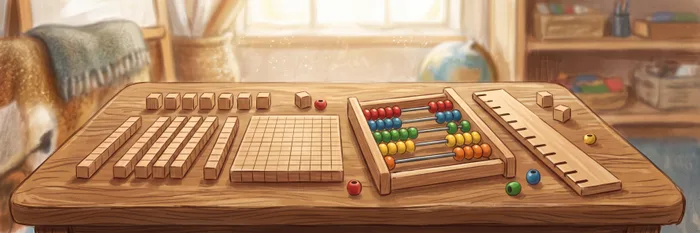
Numbers & Place Value
Vedic Maths — ten methods
Every method the Thai contest names, worked line by line on your own numbers.
Start learning →Place-Value Builder
Build numbers with base-10 blocks; read expanded form.
Start learning →Number Bonds
Split a whole into two parts (bonds to 10 & 20).
Start learning →Compare & Order Numbers
Use <, =, > by comparing place values.
Start learning →Rounding Numbers
Round to the nearest 10 or 100 on a number line.
Start learning →Skip Counting & Patterns
Count by 2s, 3s, 5s, 10s; spot patterns.
Start learning →Negative Numbers
Add and subtract integers on a number line.
Start learning →Ratio & Proportion
Simplify ratios and solve proportions.
Start learning →Counting to 20
Tap, count one-by-one, count on, and number order.
Start learning →Counting to 100
Hundred chart: down is +10, across is +1.
Start learning →Factors & Multiples
Factor pairs, common factors, HCF and LCM.
Start learning →Roman Numerals
Read & write I V X L C D M with add/subtract rules.
Start learning →Ordinal Numbers
1st, 2nd, 3rd — position words & the -st/-nd/-rd/-th rule.
Start learning →Number Line Intro
Read a 0–20 line; hop right to add, left to subtract.
Start learning →Divisibility Rules
Quick tests for ÷2, 3, 4, 5, 6, 9 and 10.
Start learning →Estimation Strategies
Round to estimate, then check if an answer is reasonable.
Start learning →Absolute Value
Distance from zero on the number line — always ≥ 0.
Start learning →Scientific Notation
Write big & small numbers as a × 10ⁿ.
Start learning →Square & Cube Numbers
See n² as an n×n grid and n³ as an n×n×n cube.
Start learning →Odd & Even Numbers
Pair two-by-two; use the last digit to tell them apart.
Start learning →
Operations
Addition Facts to 20
Add single digits fast with the make-ten trick.
Start learning →Subtraction Facts to 20
Count back, count up, and know your bonds fast.
Start learning →Mental Math Strategies
Round & adjust, split, and count up for 2-digit sums.
Start learning →Division with Remainders
The remainder — and round up, round down, or keep it.
Start learning →Two-Step Equations
Solve ax + b = c: undo +/− first, then divide.
Start learning →Multiplying & Dividing Integers
Sign rules: same signs +, different signs −.
Start learning →Distributive Property
Split hard multiplies: a×(b+c) = a×b + a×c.
Start learning →Word Problems: Choosing the Operation
Read the story, then pick + − × or ÷.
Start learning →Fact Families
Three numbers, four facts — how +/− and ×/÷ undo each other.
Start learning →Multiply & Divide by 10, 100, 1000
Digits slide across place-value columns, not 'add a zero'.
Start learning →Addition with Regrouping
Carry across columns with base-10 blocks.
Start learning →Subtraction with Regrouping
Borrow a ten with base-10 blocks.
Start learning →Multiplication Arrays
See multiplication as rows of dots.
Start learning →Times Tables & Patterns
Master facts 1–12 with memory tricks.
Start learning →Division as Equal Sharing
Share into equal groups; find the remainder.
Start learning →Long Division
Divide, multiply, subtract, bring down — step by step.
Start learning →Simple Equations
Balance the scale to solve for x.
Start learning →Prime Factors
Factors, primes, and factor trees.
Start learning →Order of Operations
Brackets, then ×÷, then +−.
Start learning →Exponents & Squares
Powers, perfect squares and square roots.
Start learning →Long Multiplication
Multiply big numbers with the area box model.
Start learning →Bar-Model Solver
Singapore bar models for word problems.
Start learning →
Fractions, Decimals & Percent
What is a Fraction?
Equal parts of a whole; numerator & denominator.
Start learning →Equivalent Fractions
See why 1/2, 2/4 and 3/6 match.
Start learning →Simplifying Fractions
Reduce fractions to lowest terms with the GCF.
Start learning →Fractions on a Number Line
Place & read n/d on a line, even past 1.
Start learning →Adding & Subtracting Decimals
Line up the points, add or subtract column by column.
Start learning →Multiplying Decimals
Multiply as whole numbers, then count decimal places.
Start learning →Rounding Decimals
Round to whole, tenth, hundredth — round half up.
Start learning →Dividing Decimals
Shift both numbers so the divisor is a whole number.
Start learning →Fractions, Decimals & Percents
The FDP triangle — one amount, three ways.
Start learning →Percentage of an Amount
Find a percent of a quantity — 25% of 80 = 20.
Start learning →Percentage Increase & Decrease
New amount after a % change, and the % change itself.
Start learning →Decimal Place Value
Ones, tenths, hundredths, thousandths & expanded form.
Start learning →Compare & Order Decimals
Line up points, compare place by place: 0.45 < 0.5.
Start learning →Fraction Word Problems
Fraction of an amount + add/subtract in a story.
Start learning →Compare Fractions
Decide which fraction is bigger with <, =, >.
Start learning →Adding & Subtracting Fractions
Combine fractions, simplify the answer.
Start learning →Multiplying & Dividing Fractions
Multiply tops & bottoms; flip to divide.
Start learning →Mixed Numbers & Improper Fractions
Turn 7/4 into 1¾ and back.
Start learning →Fraction of a Quantity
Find a fraction of a group (3/4 of 12).
Start learning →Understanding Decimals
Tenths, hundredths, and decimal-fraction links.
Start learning →Percentages — Intro
Percent as per hundred; percent of a quantity.
Start learning →
Measurement, Time & Money
Reading a Calendar
Days, months & finding which day a date falls on.
Start learning →Reading a Thermometer
Read °C below zero, find a rise, fall, and difference.
Start learning →24-Hour Time
Read 14:30 as 2:30 pm — convert with +12 / −12.
Start learning →Mass & Weight
Read a scale, convert grams and kilograms.
Start learning →Speed, Distance & Time
speed = distance ÷ time, with the D–S–T triangle.
Start learning →Reading Scales
Read rulers, jugs & number lines where each tick > 1.
Start learning →Making Change
Change = paid − cost; count up, fewest coins.
Start learning →Measuring Length
Read a ruler in cm & mm, then convert mm↔cm↔m.
Start learning →Unit Price & Best Buy
Price per unit — spot the better value.
Start learning →Time Word Problems
Find finish, start, duration + add durations.
Start learning →Telling Time
Read an analog clock to 5 minutes.
Start learning →Elapsed Time
Count on to find how much time passes.
Start learning →Counting Money & Change
Count coins and notes; make change.
Start learning →Units & Measurement
Convert metric length, mass and volume.
Start learning →Volume & Capacity
Count unit cubes to find a box's volume.
Start learning →
Geometry & Data
Area & Perimeter
Squares inside vs distance around a rectangle.
Start learning →Angles
Measure and classify angles in degrees.
Start learning →Types of Triangles
Classify triangles by sides and by angles.
Start learning →Classifying Quadrilaterals
Name shapes by parallel sides, equal sides & right angles.
Start learning →Parts of a Circle
Radius, diameter, circumference & area (π=3.14).
Start learning →Lines & Angles
Parallel, perpendicular & angle pairs on a line.
Start learning →Pythagorean Theorem
a² + b² = c² for right triangles.
Start learning →Reading Line Graphs
Read values, find peaks and trends on a line graph.
Start learning →Reflections on a Grid
Flip points across the x-axis, y-axis, and y = x.
Start learning →Rotations About the Origin
Turn a point 90°, 180°, 270° clockwise or anticlockwise.
Start learning →Polygon Interior Angles
Split polygons into triangles: (n−2)×180°.
Start learning →Reading Pie Charts
Read each slice as a fraction, percentage and count.
Start learning →Sorting 2D Shapes
Name shapes and count their sides and corners.
Start learning →Translations on a Grid
Slide points by a vector: (x,y) → (x+a, y+b).
Start learning →Tally Marks & Frequency
Record counts in fives, read a frequency table.
Start learning →Venn Diagrams
Sort into only A, only B, both & neither.
Start learning →2D Shapes & Symmetry
Sides, vertices and lines of symmetry.
Start learning →3D Solids & Nets
Faces, edges, vertices and unfolding nets.
Start learning →Coordinate Grid
Read and plot points (x, y) on a grid.
Start learning →Reading Bar Charts
Read values off the scale; compare bars.
Start learning →Reading Pictograms
One symbol equals a value — read the key.
Start learning →Mean, Median, Mode & Range
Four ways to summarise a data set.
Start learning →Basic Probability
How likely? From impossible to certain.
Start learning →
Computing & Coding
Algorithm Steps
An algorithm is an ordered list of steps — and the order matters.
Start learning →Binary Numbers
How computers count with 0 and 1 — flip the 16-8-4-2-1 bit switches.
Start learning →Loops & Repeat
A loop runs the same instructions again and again — count what it prints.
Start learning →Boolean Logic
Light a bulb through AND / OR / NOT gates, then read the truth tables.
Start learning →Trace the Output
Read Python-like code line by line and predict what it prints.
Start learning →Variables & Values
A variable is a named box that stores a value; assignment fills it, reassignment replaces it.
Start learning →If / Else Decisions
A program picks a different path depending on a condition.
Start learning →Flowcharts
Draw an algorithm with shapes and arrows, then follow it from Start to End.
Start learning →Hexadecimal & RGB Colour
Base-16 and how computers store colours as #RRGGBB.
Start learning →Find the Bug
Read a program and its wrong output, then spot the buggy line.
Start learning →What Is a Function?
Define a function with parameters, call it with arguments, and predict the value it returns.
Start learning →Nested Loops
A loop inside a loop — see why total iterations = outer × inner by tracing every (i, j) pair.
Start learning →ASCII & Text
How computers store letters as numbers — A=65, a=97. Turn letters into codes and shift them Caesar-style.
Start learning →Pattern Recognition
Find the rule in a sequence — add, multiply, or a repeating cycle — and predict what comes next.
Start learning →Sorting (Intro)
Order a list from smallest to largest and trace one bubble-sort swap step by step.
Start learning →
Physics
Forces & Motion
Newton's 2nd law F = m·a, weight W = m·g, and resultant force — push a box and watch it accelerate.
Start learning →Energy, Work & Power
Work W = F·d, kinetic ½mv², potential mgh, power W/t — in joules & watts.
Start learning →Electric Circuits
Ohm's law V = I·R, series resistance and power P = V·I — with a live circuit you can tune.
Start learning →Waves & Sound
Change frequency and wavelength to see wave speed v = f × λ, plus period and wave types.
Start learning →Pressure & Density
Pressure P = F ÷ A and density ρ = m ÷ V — set the values live, then rearrange to find force or mass.
Start learning →Heat & Temperature
Heat energy Q = m·c·ΔT — set the mass and temperature of water, see the joules, and tell heat from temperature.
Start learning →Momentum & Collisions
Momentum p = m·v, and how it's conserved when two objects collide and stick together.
Start learning →Light & Optics
Change the angle of incidence to see the equal reflection angle live, plus refraction and the thin-lens equation 1/f = 1/dₒ + 1/dᵢ.
Start learning →Magnetism Basics
Poles rule (like repel, unlike attract), electromagnets, and the force on a wire F = B·I·L — with a live field you can tune.
Start learning →Circular Motion
Centripetal acceleration a = v²/r and force Fc = m·v²/r point INWARD; link ω and v with v = ω·r — watch a dot orbit.
Start learning →Static Electricity
Positive & negative charge, the like-repel / unlike-attract rule, charging by friction, and everyday sparks — with a charge sandbox you can rub.
Start learning →Gravitation
Weigh yourself on the Moon, Mars and Jupiter — W = m·g — and meet the inverse-square law F = G·M·m/r².
Start learning →Modern Physics
Photons E = h·f, the photoelectric effect, mass–energy E = m·c² and half-life — with a live decay you can step through.
Start learning →Ready to put it all to work?
Always-correct worksheets, a full classroom system, and the paperwork — all in one place. Start free.